Back into the swing of things, this freshest episode features a lot of modern compositions as which include some interesting techniques you may not have thought about.
Callum Au – Swipe Right!
Released this year, Callum Au put together some of the finest musicians in the UK and composed some belters for them to play
Swipe Right! is the introduction to the album, and this chart captures the fun, snappy, Gen-Z-ness of the title very well.
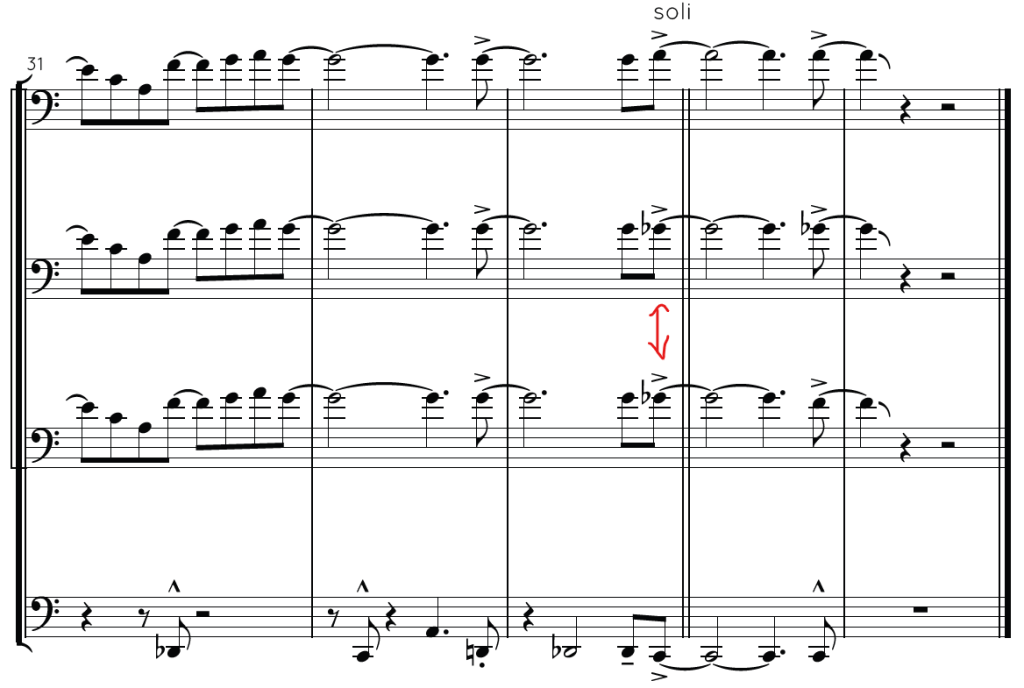
Firstly to say, it’s an extremely challenging soli. However, there are a few arranging decisions that help take some of the pressure off the players without affecting the overall sound.
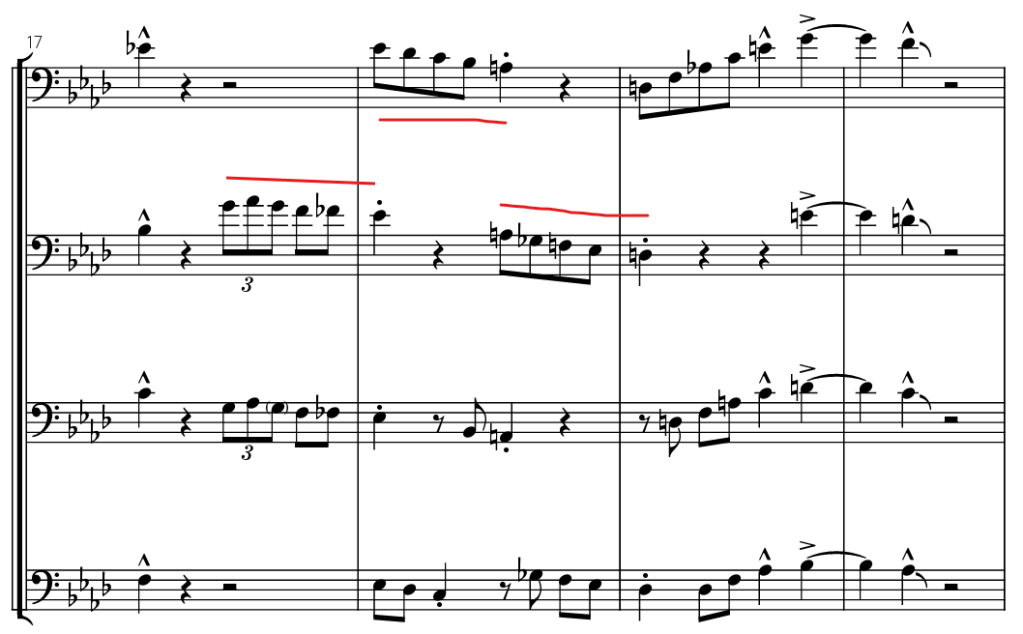
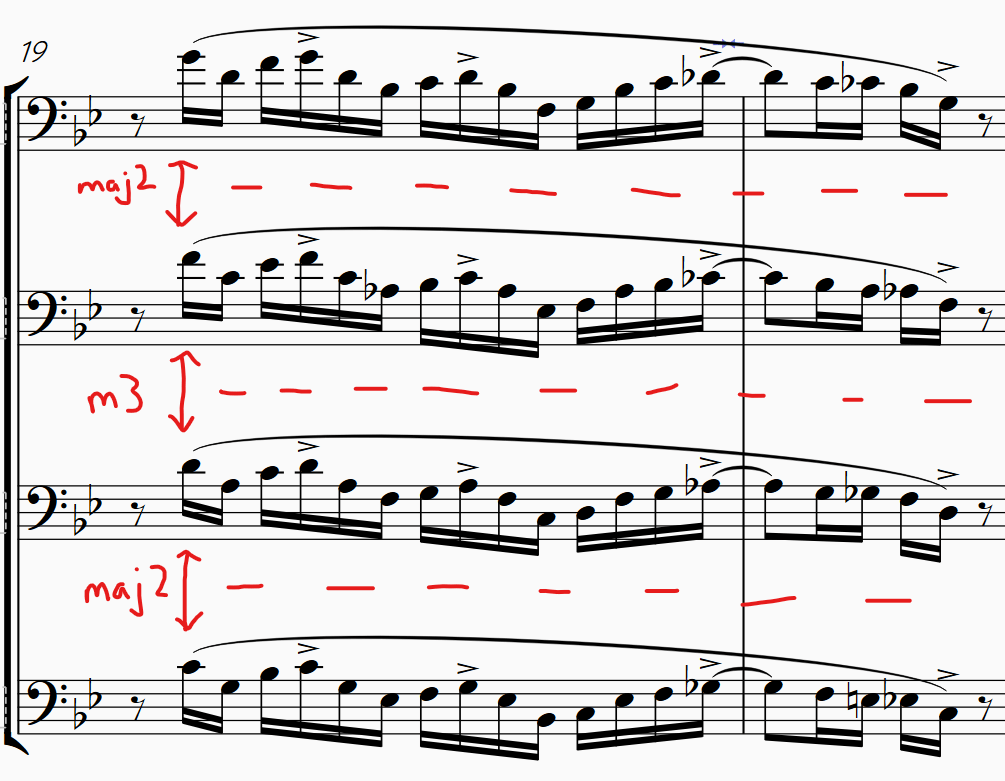
Below we see this unison line divided up amongst all the players, giving players some breathing space whilst maintaining the melody (semi Donna Lee-inspired). You can still hear the melody very clearly whilst eliminating the tough challenge of playing the 8th note line for the whole 2-measure duration.
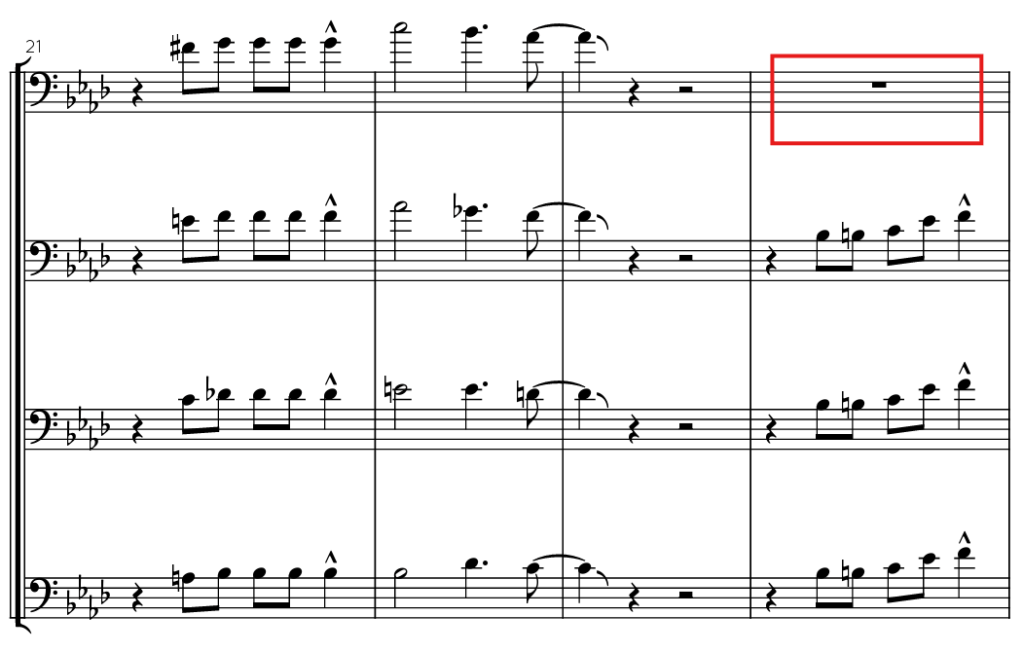
Another subtle thing is the elimination of this unison part in Trombone 1. It gives more time for the player to prepare for the laser-high phrase to come. You’ll see this a lot more in Trumpet 1 parts, as they need to save some lip for the screaming.
Bob McChesney is an unbelievably delicate trombone soloist, and this chart composed and arranged by Elliot Deutsch really compliments his sweet sound
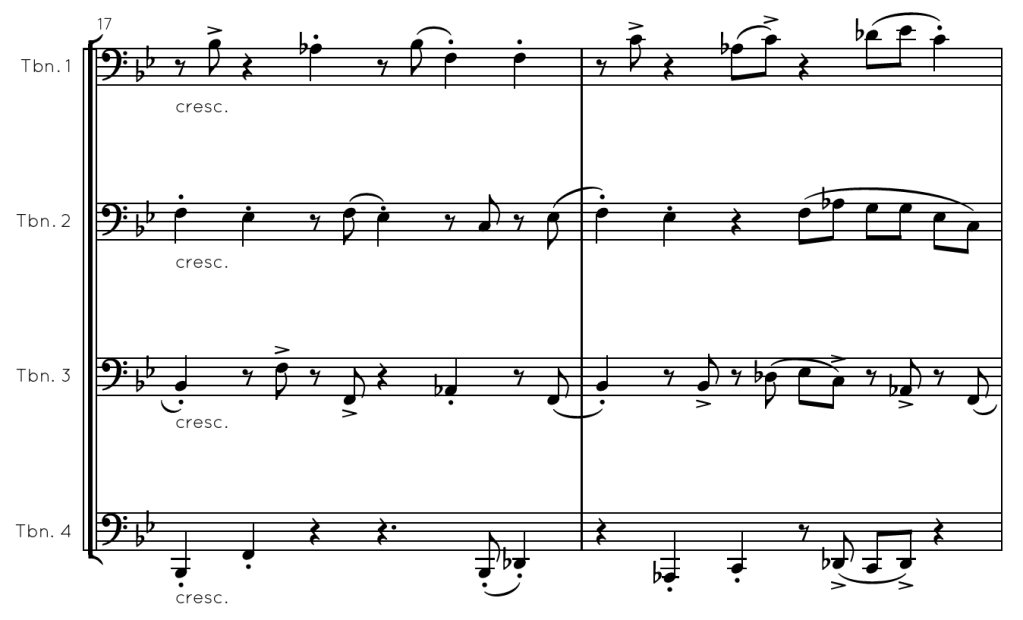
What intrigued me about this soli is how low in the register this begins. These low block voicings usually create a muddy sound, but with all the rhythm dropped, the effect is rather warm, with the lower voices under Bob feeling like a soft cushion. Bob’s natural sound also helps smoothen these lower bits out too.
Even though it is low in the register, the rule of keeping at least a third from the melody (for the most part) is maintained through here.
By far one of the weirder arrangements I’ve covered. Bill Holman compositions always manage to surprise me with the interesting textures he can create.
This opening of Rear View has a few arranging approaches I had no seen before. First are the rhythmic stabs in the trombones. Whilst the saxophones and trumpets are playing their own unison melody, the bones are playing these major triads, which creates this almost ironic, loopy feeling.
A great viewer suggestion, this one certainly gets the slide moving.
Nothing too crazy to say about this one! I enjoy when the bass trombone stabs come in, as well as when Trombones 1-3 come out of unison to play the A and G♭, with two bones on the G♭ making it sound extra powerful… they then split two play a crunchy C13sus#11 chord.
Decided to finish on a more mainstream song, and I realised I hadn’t included any Latin-style pieces. Willie loved to included bones on his recordings, and this certainly enhances the rich ending to the song.
Thank you for watching the tenth episode of Big Band Trombone Moments. In this post, we’ll break down what makes these trombone parts so good to listen to.
Dance of Life (Bob Curnow Big Band)
Bob Curnow is most known for his collaboration with the Stan Kenton Orchestra, being a staff arranger and trombonist for the band from around the 1960s.
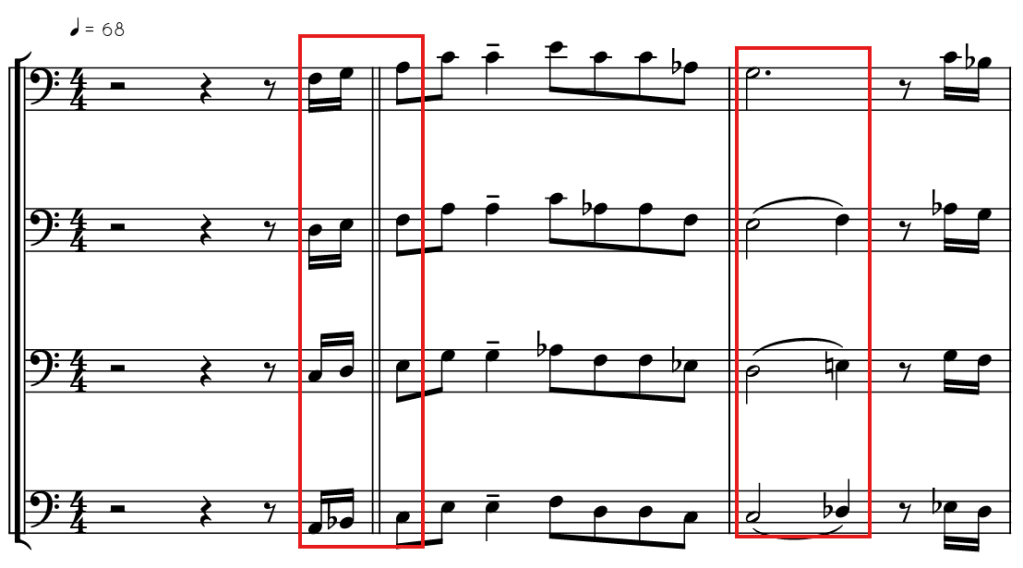
The Dance of Life was a great opener to the episode for it’s gradual build of trombones. It’s rare to see all four trombones playing independent melodies, but I guess there’s a lot of room for different rhythms with two lengthy 6/4 bars.
The first statement from the bass trombone outlines the key very clearly by playing the root and fifth on the first two downbeats of the piece. This helps the other trombones when they enter as just these 2 notes help provide a sense of pulse for them to follow.
A popular example I can think of where the trombones build up individual rhythms is in Nelson Riddle’s arrangement of I Got You Under My Skin, where it builds up into that wailing trombone solo. A great technique to create some energy!
This classic arrangement by Reg Owen was originally played by Ted Heath & His Orchestra. This recording by the Swiss Army Big band however is so rich and energetic, and the bari really thumps out the bass line perfectly.
No independent rhythms here, this is a fantastic example of block voicing. The trombone are written in that golden spot where the chords sound thick and rich but not muddy. There is also always at least a third between the 1st and 2nd trombone, with tighter intervals lower in the section.
A track from this Joe Gallardo album has been featured before, but the trombones sound so MUSHY on this track that I had to feature it. Also, a samba chart has got to make it to the episode somehow.
We have more examples of block voicing here, however in this example we see some more note choices instead of the typical 1st, 3rd, 5th and 6th/7th that we see in Hot Toddy.
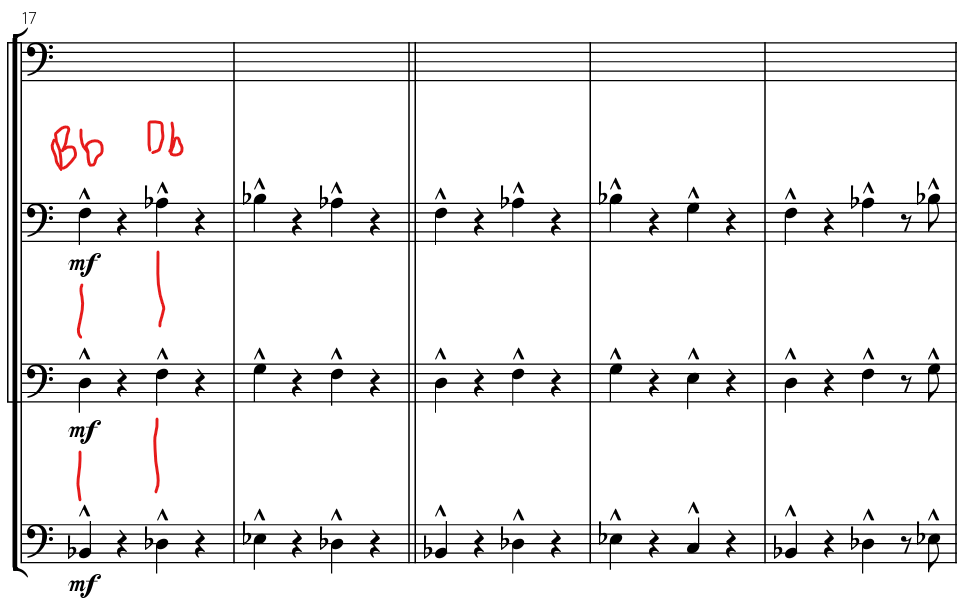
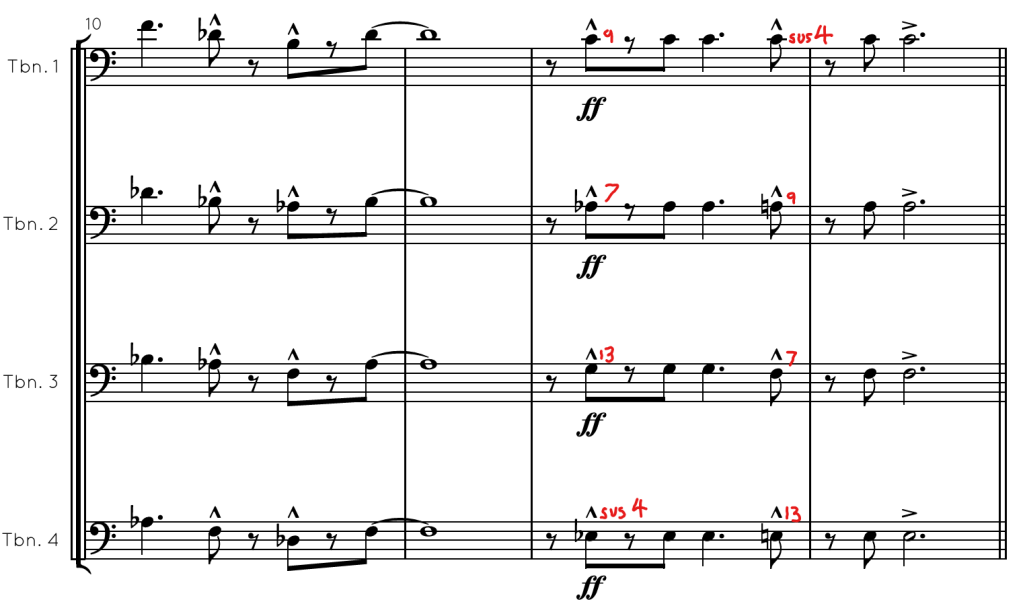
From the 12th bar of this moment, we see what seems like 2 major chords in the trombone, Abmaj7 and Fmaj7, which provide some nice crunch between the major7th and root note, voiced lower in the chord.
However, the bass note for these 2 chords are Bb and G respectively, which means these chords could either be labelled Abmaj7/Bb and Fmaj7/G, or, as these chords are resolving to C6, it would be better to think of them as dominant chords, renaming them to the chords Bb13sus4 and G13sus4.
Another great recording… This arrangement of Just Friends by Rob McConnell is a fantastic band showcase, I particularly enjoy the quiet ensemble section just after the introduction, all the instruments move seamlessly together.
This unison trombone soli (and bass!) had to featured at some point, it’s very often requested on each episode! There isn’t too much to say about this, apart from that this explores the entire comfortable range of the for the advanced tenor trombonist and is a great passage to practise for fast swing technique. Every trombone should try conquer it at some point!
I love to dial it back in the middle of a BBTM episode, and what better way to do so than with juicy five-note trombone pads behind a piano solo.
The composer of this tune, Pete Rugolo, started working with Stan after the First World War.
There’s two satisfying chords I’d like to pick out. One is the in the 7th measure of the excerpt, where we have Dmaj7#11 chord voiced with the #11 and 5th at the bottom of the chord a half-step apart. This leads nicely into the next chord of Dbmaj7(add6) with the A going up to Bb (6th) and the Ab staying on Ab (5th).
There is also the D7(b5,b9) chord at measure 20. This chord ALMOST stacks up perfectly in fourths, and also compliments the top line of the 1st trombone really well, keeping it melodic whilst also providing tension.
You also see these Dbmaj7(add6) chords throughout this piece in the trombones, with the Ab, Bb, and C voiced closely together however it doesn’t sound muddy.
Unfortunately, Gordon Goodwin passed away late last year. He revitalized the big band genre for today’s generation and as is a huge reason of why I enjoy this music in the first place. This tune is no exception to his bold repertoire, and makes perfect sense due to his love for whacky film music in episodes of Looney Tunes.
This trombone soli comes at the start of the piece just after the saxophone soli and is completely unaccompanied until the end.
A few things to note about the writing that makes it rather unique is the use of staccato, straight 8th notes throughout. It’s rare to see this in a big band chart for an extended amount of time and this gives the chart and extra layer of cheekiness.
You also see Gordon’s understanding of dynamics for brass with the alternating loud and quiet bars. Loud sections stretch up to the top C, which is very difficult to play cleanly at a soft dynamic. Then the soft sections come down more than an octave for most players, giving the player plenty of time to adjust their embouchure to play in this different range and dynamic.
This piece was discovered after I was reading about Tommy Dorsey’s life for an upcoming video. His band are unbelievably tight. When the saxes come in after the trombones enter, they are so together and in-tune.
Tom Foolery is not actually composed by Tommy Dorsey, it was named after another Tom named Tommy Todd. There is nothing much else credited to Tommy Todd apart from this number.
Apart from the effortlessly played blocking voicing from the band, we see the use of the turn in measure 5 of the excerpt, and also some great examples of counter melody in the saxes which doesn’t distract you too much from the trombones’ melody.
This recording is so compressed, it makes the rhythm section sound massive. This Nestico arrangement was composed later in his life, around 2011, and features the four bones on solos as well a classic Nestico shout section before the trombone moment.
I enjoy all the jazz articulations that Sammy uses in this soli, including turns, scoops, and ghost notes; it invites the player to play more soloistically, as these articulations are usually featured naturally in any swing trombone solo.
I’ve played this piece many times in big bands, so I thought I would give it the proper dedication and include it in this episode.
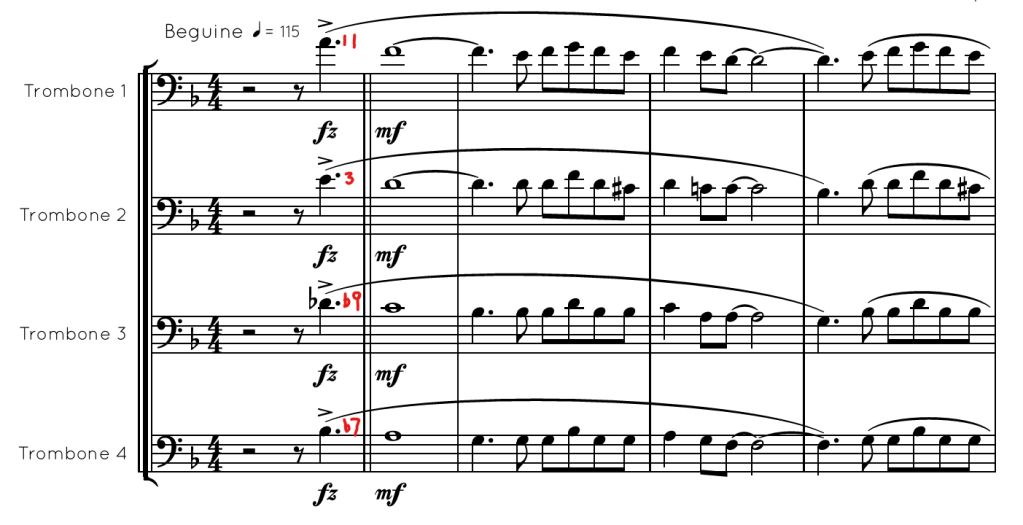
One thing I have been obsessed with recently is the use of dominant chords with an eleventh in, which this soli begins with. The soli begins with a C11b9 chord, with the 1st trombone playing A (11th) and the bass trombone player the 7th (Bb). Whilst clashy, the A is part of the F pentatonic scale, making it a likely note for a melody line. It also a provides a great voice leading in the trombones for the F6 chord.
Lastly but definitely not least is this fantastic swing chart by Makoto Ozone. The whole concert is amazing, with other charts like Jungle where the band starts with a lot of animal noises, and No Siesta which is an incredibly challenging samba tune.
It’s rare you will see semi-quavers in a big band swing chart from trombones, but the WDR Big Band trombone section can certainly handle it. This passage has the bass trombone 2 octaves down from the other 3 trombones in unison and is certainly unexpected.
When the rest of the horns enters for the shout section, we hear the trombones back in unison, playing scooped flat 3rds (Cb) which can really be heard over the rest of the horns.
This end of this piece isn’t featured in this episode, but it’s a really cheeky trombone moment if you do listen.
Thanks for watching another episode of BBTM! It’s been a while, but this episode features some real, high-quality recordings.
Below you shall find YouTube links to all the recordings featured, accompanied with a small analysis of the trombone moment, and of course the download to the PDF. If you have any suggestions for future episodes, feel free to comment on the video, or drop me an email via the description.
Invitation – Airmen of Note
Invitation is a song arranged by the talented Mike Crotty.
At first, I thought my ears deceived me. 6 trombones?! Surely not! But listening to the intro several times, it’s clear you can hear six individual voices entering, with Dave Steinmeyer soaring in at the end.
What I enjoyed most about this intro was how the II-V-I was voiced for each chord, as there are never any overlapping chord tones in the trombone parts (apart from the A in the C#+7(#9)).
Keeping the bottom 2 voices either a 7th or an octave and a 3rd away saves the dense chord from sounding too muddy. The middle voices in this range sound the best when notes are closely voiced. I’ll be sure to borrow this 6 note-voicing technique when applying it across a whole big band.
I first came across this song from playing it in a big band, and it’s rare to get some fun trombone solis in a vocal number! This particular arrangement of Too Darn Hot is by Buddy Bregman, who conducted and arranged for Ella Fitzgerald, leading to two best-selling albums in 1956; the Cole Porter Songbook and the Rodgers and Hart Songbook.
This small, 8-bar moment comes in the pieces B section, where the piece temporarily travels to C major from the home key C minor.
What I found distinctive about this closed-voiced soli section was the vast amount of 6 chords (eg. C6, Fm6, and Bb6(b5)) that Bregman resolved to. The difference between a F6 and an Fm6 compared to Fmaj7 and an Fm7 is that only one note changes in the chord compared to 2, meaning the sudden key change isn’t so jarring and noticeable, in my opinion.
Cha-Cha Toda la Noche – Jazz at Lincoln Center Orchestra
This piece was part of program of music arranged and composed by trombonist Christopher Crenshaw for the Jazz at Lincoln Center Orchestra.
Some noticeable things about this 3-voice soli is bar 5 where we get a temporary semitone clash between the 2nd and 3rd trombone. Other options could have been the 3rd trombone playing an F# instead of a G#, however, it means the 3rd trombone is repeating the F# in the next bar which is poor voice-leading. Also, you don’t get nearly as much tension with the F#, giving you a B7 chord instead of the crunchier B13 that Christopher has written.
You can hear Christopher Crenshaw go into depth about a lot of the pieces on the program at this YouTube masterclass.
A classic by Neal Hefti that has been given a fresh coat by Jörg Achim Keller. The original track on the album The Atomic Mr Basie only includes 3 trombones, so it’s interesting to see how Jörg has added the bass trombone part.
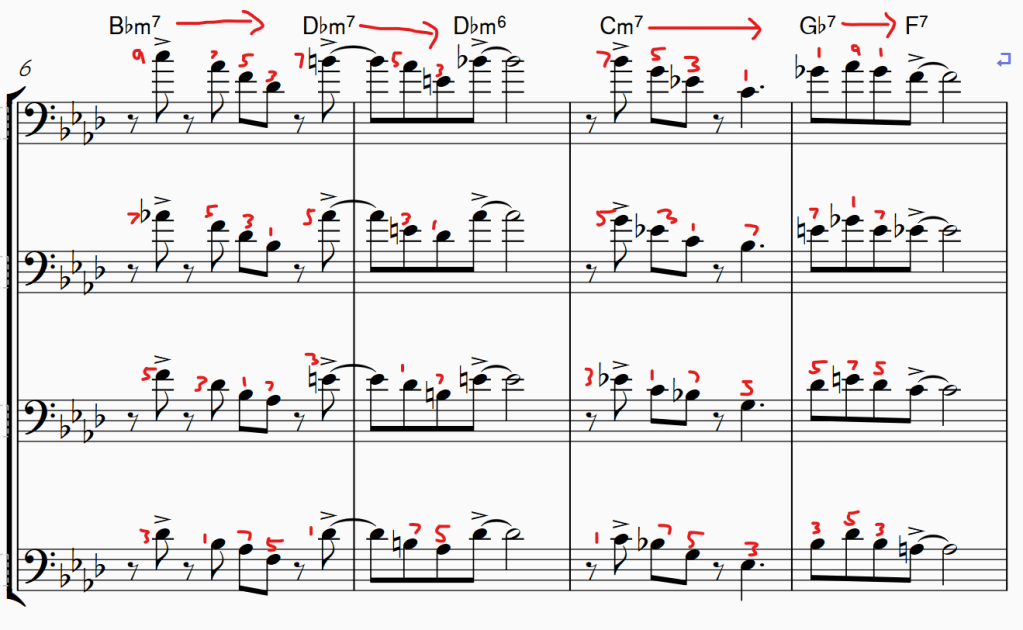
For the first 6 bars of this soli, the bass trombone matches the 2nd trombone part and octave down, as they’re playing the root of the chord. At bar 7, we get 4 separate voices, giving us a Bbm6 chord. Jörg could have used an Ab here but it doesn’t match the descending pitches of the other parts, and also the muddy interval between the 2 lower trombone parts is exaggerated the closer the bottom part gets to the Db in the 3rd Trom.
I’ve recently been fascinated by Latin Jazz and it’s influence on jazz as a whole after reading the book Latin Jazz by Christopher Washburne. This whole album, Latin Jazz Latino, by trombonist Joe Gallardo and the NDR Big Band covers a range of styles and rhythms you should definitely listen to.
The sub-genre of Slidin’ Home is son montuno which usually incorporates fast & complex horn arrangements, and this certainly exemplifies that! It features 2 solo trombones and the complex, sycnopated rhythms stretch far from it featured in my video.
Thanks for watching another episode of BBTM! This episode featured viewer suggestions as well as pieces I had come across from playing myself recently.
Below you shall find YouTube links to all the recordings featured, accompanied with a small analysis of the trombone moment, and of course the download to the PDF. If you have any suggestions for future episodes, feel free to comment on the video, or drop me an email via the description.
No Home No – WDR Big Band
No Home No is a composition by the extremely talented trombonist Rita Payés, which was expanded out for Big Band by Michael P. Mossman.
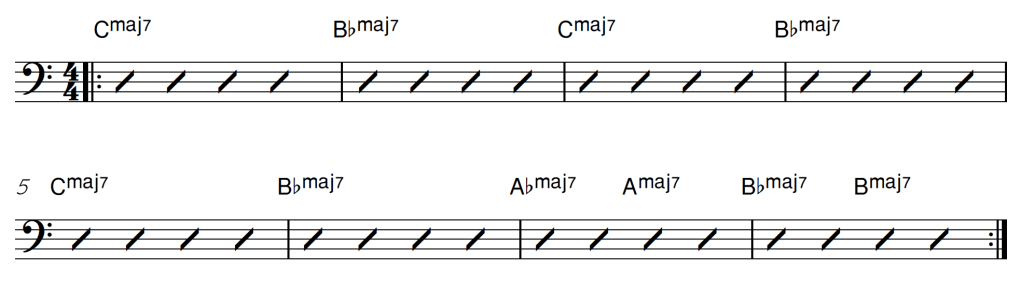
The piece begins with the bass trombone motif; a meaty fifth down to pedal C which Mattis Cederberg plays with ease. The bass trombone also outlines the chord structure, where we shift around major7 chords.
Then, each trombone enters individually with their own counter melodies, occasionally interlocking with another part.
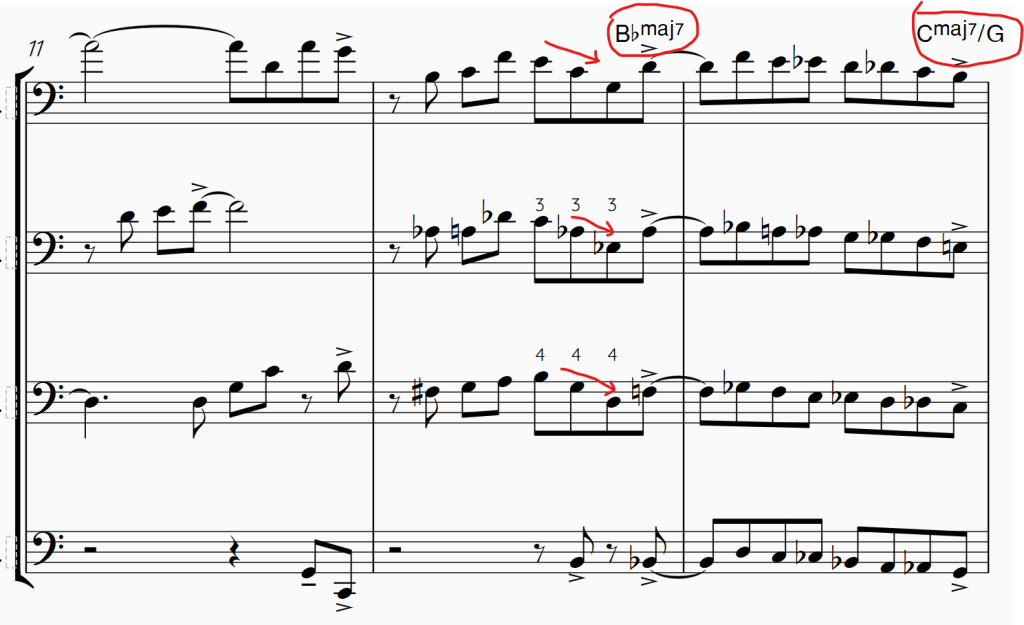
Once we get to measure 11, the top 3 bones play this seemingly clashy eighth note motif, where the 2nd & 3rd trombone are a half step apart for most of the bar. In the recording, this comes across as quite a cheeky moment before resolving to the Bbmaj7 chord into the next measure. As each part is descending quickly, you don’t really notice the pitches of the trombones. Mossman most likely wrote the trombone parts like this to keep the slide movement to a minimum.
After this Bbmaj7 resolution, all bones are finally interlocked with this fantastic chromatic descending line which leads to Cmaj7 second inversion.
From the album AIR Power!, this chart certainly demands the best out these players.
Apart from the superb playing, we hear a range of unison and soli moments which help bring a sort of tension and relief.
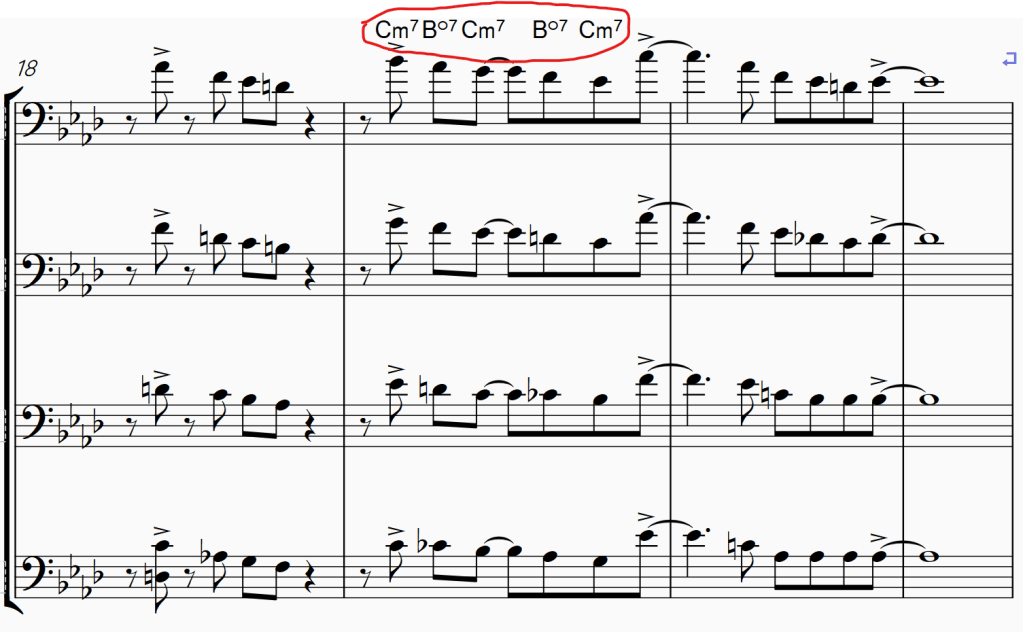
In the final 8 measures, the full range of the trombones is displayed. Before this, the bass trombone sits around a third away from the 3rd part, and rarely stepping into it’s pedal range. The 1st and 4th trombone are a whole 3 octaves apart, which really exposes the technical ability of the players, leaving little to blend with. Meanwhile, the 2nd and 3rd part are, at most, only a tone away from each other, providing the crunchiness whilst the respective bones are miles away!
This arrangement of a Disney tune from Pinocchio is by Callum Au, an Oxford-based arranger and trombonist.
This piece mainly features 2 trumpets on the melody, but for just 4 measures, we are presented with a soothing trombone soli.
The first trombone sings the melody, where the other trombones accompany with slightly less-active harmonies.
The key moment comes in third measure, where we get a cascading bell effect, outlining an Amaj7#5; a great chord to use if you want a bit of tension during a maj7 chord.
This piece may sound slightly familiar to you, and you’d be right to think that this is similar to the popular Four Brothers tune; they are both arranged by Jimmy Giuffre!
This 32-measure, AABA structure showcases some great essentials and tools in soli writing. In the beginning section, we see the trombones mostly following the outlines of chords with various arpeggios, with the occasional use of the ninth
The B section presents a more step-wise melody, showcasing more of these diminished passing chords.
Always great to end on a bit of funk! What was different for me was discovering this chart was wrote with 1/16-note swing in mind, instead of 1/8-note which is what I am used to. I was surprised how clear it was to read the rhythms if the notes were properly edited!
This chart features a few modern techniques in it’s writing. Firstly, we haven’t got any backing chords from the rhythm section, which gives a lot of freedom in what Mike Tomaro can write.
One modern technique we see is the use of parallel motion; the intervals between the trombones remain the same throughout this phrase in measure 19.
It’s also heard again in measures 23-25, with the tonal center shifting chromatically upwards too.
All recordings and downloads of the seventh episode of the series!
Welcome to another episode BBTM, where we take a look at some lesser-known pieces with some rather satisfying bone moments
The aim of these blog posts is to dive in a little deeper into the charts and why they sound so good.
Bag’a Bones – Count Basie Orchestra
A recording from 1961
Composed and arranged by Neal Hefti, this piece features on an album called Basie Plays Hefti, alongside famous charts like Cute and Pony Tail. It was recorded in 1958, where the version of Bag’a Bones is a little slower than what we have in the above live performance.
The arrangement has the trombones in unison for the beginning of the piece, where we see this fast and difficult gliss up 2 octaves (you can hear some players splitting it!) It makes for a very effective and dramatic opening statement.
A Step Beyond – Towson State University Jazz Ensemble
This recording is the best version I could find of the soli, which makes sense as it the ensemble is directed by J. Hank Levy himself! With this version, you also might be able to tell that it’s about half a semitone flat, probably due to the nature of the recording. In my video, I re-tuned it, which made it a lot easier to transcribe.
This whole chart is extremely challenging for everyone involved, with tricky syncopation and harmonies everywhere. In this stellar recording of the always great Airmen of Note, we hear the bari sax replaced by a very juicy bass saxophone.
Malaga – Central Washington University Jazz Band 1
This university big band are fantastic, even the recording quality is great. We have featured this band in a previous episode with the trombone soli on A Little Minor Booze.
This piece is arranged by the bass trombone player in the recording, Mattis Cederberg, and it provides a very fresh, fun take of the usually overplayed Christmas classic.
This episode is filled with banger after banger, and even managed to find some more Lawrence Welk Orchestra recordings of their great trombone section, after lots of people enjoyed ‘Little Girl’ from BBTM #6.
The aim of these blog posts is to dive in a little deeper into the charts and why they sound so good.
23°N 82°W – Stan Kenton Orchestra
This piece is William Russo’s most requested work. The 5 trombones are blasting out 3 different low melodies, with a lot of a very satisfying F’s and Bb’s. One thing to notice is that when the third melody is introduced, there is no quaver which a trombone isn’t playing in, giving it this forward momentum.
This recording is sublime, the bass trombone, played by Jeff Cortazzo, really does make your head vibrate with those stanky low notes. Other trombonists featured on this tune are Bill Holmes, Harry Watters, and the arranger and lead trombone, Matt Niess.
My favourite bit from this soli is from the climax after the first 16 bars. All the trombones leap into the high register with this tasty, laid-back phrase. The lead trombone goes chromatically up and down in these first 2 bars, where you would expect the other trombone parts to do the same. However, we have the 2nd and 3rd bone going back down to their first note and the 4th bone staying on their Eb. The slight variety of intervals makes each part stand on its own.
The tight voicing of the bottom 3 trombones (landing on G, F, and Eb) also makes this moment even juicier to the ears.
East of the Sun & West of the Moon – Lawrence Welk Orchestra
After finding Little Girl performed by this Orchestra, I have always been on the lookout for more from these guys. They absolutely love to vib!
Although the arrangement maybe simple, the last bars saw all the trombones rising a whole octave on this Db6 chord. The voicing of this chord is perfect, with the tonic on top and the 6th a third underneath the lead (Bb).
This piece a whole features Pasquale Grasso on guitar, and I always love to feature some WDR Big Band on these videos as the recording and playing are always super high-quality.
One thing I noticed with this soli was how often the occurance of Major 7th and Minor 2nd intervals were featured. They sound especially good on trombones due to the extremely bluesly nature of them. One place that features this the most is from bar 13 of the trombone soli.
March of the Tadpoles – Toshiko Akiyoshi Lew Tabackin Big Band
Blimey this is fast…
Apart from these light-speed passages we get through out, there are definetely alot of interesting arrangement choices from Toshiko Akiyoshi.
Towards the end of the soli, from bar 65-66, the 1st and 3rd trombone are in unison as well as the 2nd and 4th bone, apart from them being an octave apart. The unison helps it to feel like a really triumphant moment in the piece.
Also, the fast gliss up the harmonics can all be played in 2nd and 3rd position with the 1st and 3rd parts, giving the reason for how fast the players go through these notes, as they don’t need to move the slide much. With the 2nd and 4th parts, it’s pretty similar, apart from starting on a Db in 5th position, but they can gliss up the harmonics in 6th and 7th position, as shown with positions below.