Thank you for watching the tenth episode of Big Band Trombone Moments. In this post, we’ll break down what makes these trombone parts so good to listen to.
Dance of Life (Bob Curnow Big Band)
Bob Curnow is most known for his collaboration with the Stan Kenton Orchestra, being a staff arranger and trombonist for the band from around the 1960s.
The Dance of Life was a great opener to the episode for it’s gradual build of trombones. It’s rare to see all four trombones playing independent melodies, but I guess there’s a lot of room for different rhythms with two lengthy 6/4 bars.
The first statement from the bass trombone outlines the key very clearly by playing the root and fifth on the first two downbeats of the piece. This helps the other trombones when they enter as just these 2 notes help provide a sense of pulse for them to follow.
A popular example I can think of where the trombones build up individual rhythms is in Nelson Riddle’s arrangement of I Got You Under My Skin, where it builds up into that wailing trombone solo. A great technique to create some energy!
Hot Toddy – Swiss Army Big Band
This classic arrangement by Reg Owen was originally played by Ted Heath & His Orchestra. This recording by the Swiss Army Big band however is so rich and energetic, and the bari really thumps out the bass line perfectly.
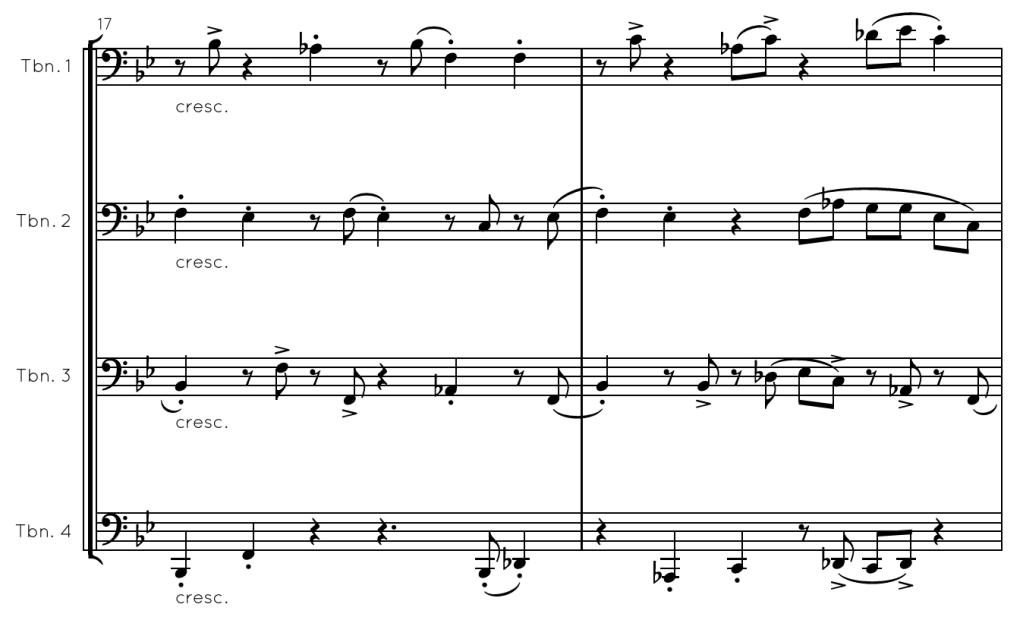
No independent rhythms here, this is a fantastic example of block voicing. The trombone are written in that golden spot where the chords sound thick and rich but not muddy. There is also always at least a third between the 1st and 2nd trombone, with tighter intervals lower in the section.
Asunción – NDR Big Band
A track from this Joe Gallardo album has been featured before, but the trombones sound so MUSHY on this track that I had to feature it. Also, a samba chart has got to make it to the episode somehow.
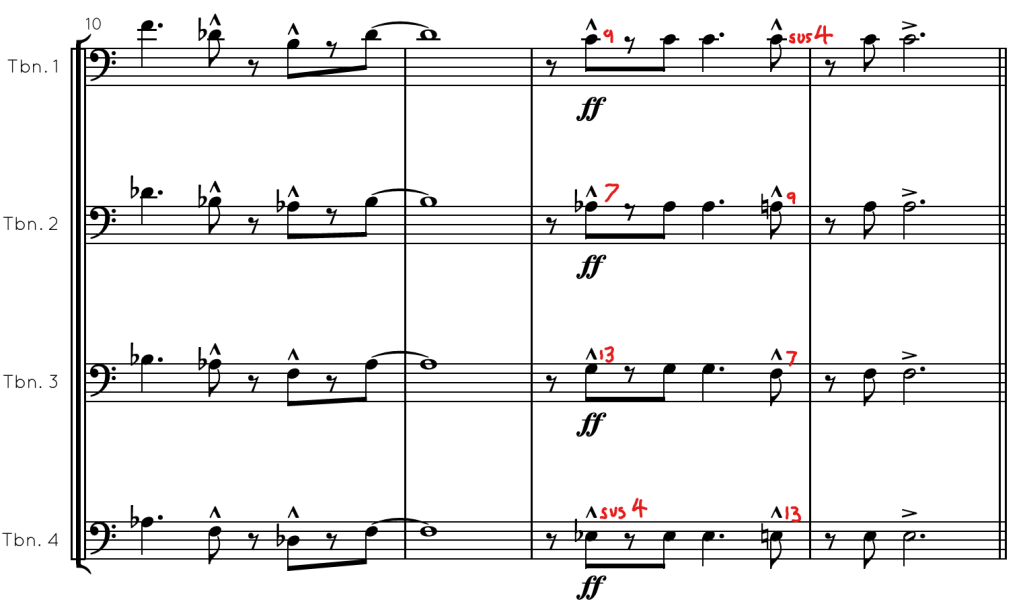
We have more examples of block voicing here, however in this example we see some more note choices instead of the typical 1st, 3rd, 5th and 6th/7th that we see in Hot Toddy.
From the 12th bar of this moment, we see what seems like 2 major chords in the trombone, Abmaj7 and Fmaj7, which provide some nice crunch between the major7th and root note, voiced lower in the chord.
However, the bass note for these 2 chords are Bb and G respectively, which means these chords could either be labelled Abmaj7/Bb and Fmaj7/G, or, as these chords are resolving to C6, it would be better to think of them as dominant chords, renaming them to the chords Bb13sus4 and G13sus4.
Just Friends – Boss Brass
Another great recording… This arrangement of Just Friends by Rob McConnell is a fantastic band showcase, I particularly enjoy the quiet ensemble section just after the introduction, all the instruments move seamlessly together.
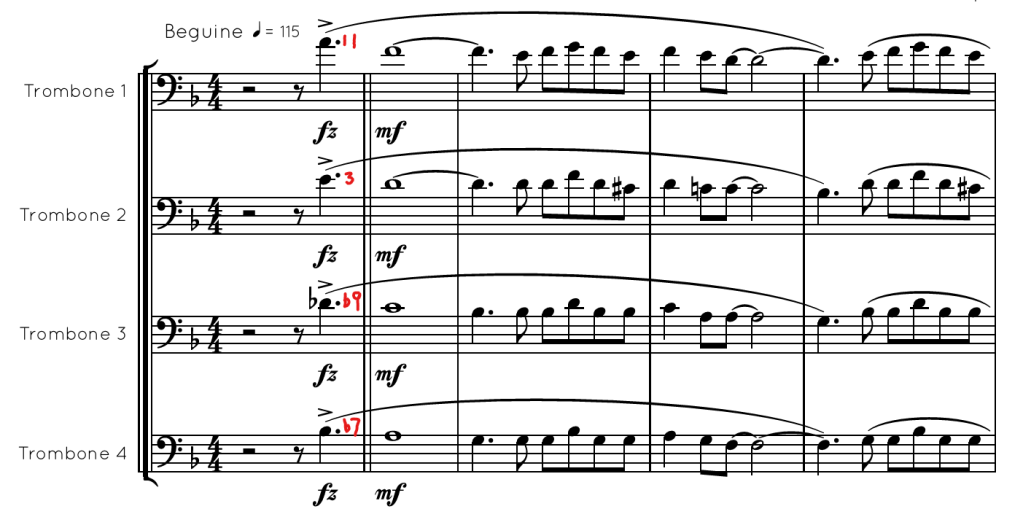
This unison trombone soli (and bass!) had to featured at some point, it’s very often requested on each episode! There isn’t too much to say about this, apart from that this explores the entire comfortable range of the for the advanced tenor trombonist and is a great passage to practise for fast swing technique. Every trombone should try conquer it at some point!
Interlude – Stan Kenton Orchestra
I love to dial it back in the middle of a BBTM episode, and what better way to do so than with juicy five-note trombone pads behind a piano solo.
The composer of this tune, Pete Rugolo, started working with Stan after the First World War.
There’s two satisfying chords I’d like to pick out. One is the in the 7th measure of the excerpt, where we have Dmaj7#11 chord voiced with the #11 and 5th at the bottom of the chord a half-step apart. This leads nicely into the next chord of Dbmaj7(add6) with the A going up to Bb (6th) and the Ab staying on Ab (5th).
There is also the D7(b5,b9) chord at measure 20. This chord ALMOST stacks up perfectly in fourths, and also compliments the top line of the 1st trombone really well, keeping it melodic whilst also providing tension.
You also see these Dbmaj7(add6) chords throughout this piece in the trombones, with the Ab, Bb, and C voiced closely together however it doesn’t sound muddy.
Hunting Wabbits – Airmen of Note
Unfortunately, Gordon Goodwin passed away late last year. He revitalized the big band genre for today’s generation and as is a huge reason of why I enjoy this music in the first place. This tune is no exception to his bold repertoire, and makes perfect sense due to his love for whacky film music in episodes of Looney Tunes.
This trombone soli comes at the start of the piece just after the saxophone soli and is completely unaccompanied until the end.
A few things to note about the writing that makes it rather unique is the use of staccato, straight 8th notes throughout. It’s rare to see this in a big band chart for an extended amount of time and this gives the chart and extra layer of cheekiness.
You also see Gordon’s understanding of dynamics for brass with the alternating loud and quiet bars. Loud sections stretch up to the top C, which is very difficult to play cleanly at a soft dynamic. Then the soft sections come down more than an octave for most players, giving the player plenty of time to adjust their embouchure to play in this different range and dynamic.
Tom Foolery – Tommy Dorsey Orchestra
This piece was discovered after I was reading about Tommy Dorsey’s life for an upcoming video. His band are unbelievably tight. When the saxes come in after the trombones enter, they are so together and in-tune.
Tom Foolery is not actually composed by Tommy Dorsey, it was named after another Tom named Tommy Todd. There is nothing much else credited to Tommy Todd apart from this number.
Apart from the effortlessly played blocking voicing from the band, we see the use of the turn in measure 5 of the excerpt, and also some great examples of counter melody in the saxes which doesn’t distract you too much from the trombones’ melody.
The Four Of Us – SWR Big Band
This recording is so compressed, it makes the rhythm section sound massive. This Nestico arrangement was composed later in his life, around 2011, and features the four bones on solos as well a classic Nestico shout section before the trombone moment.
I enjoy all the jazz articulations that Sammy uses in this soli, including turns, scoops, and ghost notes; it invites the player to play more soloistically, as these articulations are usually featured naturally in any swing trombone solo.
Perfidia – Jerry Costanzo Orchestra
I’ve played this piece many times in big bands, so I thought I would give it the proper dedication and include it in this episode.
One thing I have been obsessed with recently is the use of dominant chords with an eleventh in, which this soli begins with. The soli begins with a C11b9 chord, with the 1st trombone playing A (11th) and the bass trombone player the 7th (Bb). Whilst clashy, the A is part of the F pentatonic scale, making it a likely note for a melody line. It also a provides a great voice leading in the trombones for the F6 chord.
You Always Come Late – WDR Big Band
Lastly but definitely not least is this fantastic swing chart by Makoto Ozone. The whole concert is amazing, with other charts like Jungle where the band starts with a lot of animal noises, and No Siesta which is an incredibly challenging samba tune.
It’s rare you will see semi-quavers in a big band swing chart from trombones, but the WDR Big Band trombone section can certainly handle it. This passage has the bass trombone 2 octaves down from the other 3 trombones in unison and is certainly unexpected.
When the rest of the horns enters for the shout section, we hear the trombones back in unison, playing scooped flat 3rds (Cb) which can really be heard over the rest of the horns.
This end of this piece isn’t featured in this episode, but it’s a really cheeky trombone moment if you do listen.
Thanks so much for your support with the series!
Make a one-time donation
Choose an amount
Or enter a custom amount
Any donations are greatly appreciated! It really helps me to keep making free transcriptions for anyone to download.
Donate
 Jed R Music